
Accessories / Troubleshooting
CabKing Water Flow Problems: Checks from the Official Manual
Identify supply, branch and drainage symptoms before ordering a pump or changing the water system.
Research-based guide · We have not physically tested these products. How we research
Jump to a section
THE SHORT ANSWER
If a CabKing loses water flow, stop grinding and identify whether the problem affects all outlets or one branch. The official manual points first to supply water, pump power, tube connections and blocked nozzles or Y-splits. Do not run a dry wheel to continue a job or turn a flow problem into an electrical repair.
| Observation | First area to inspect while safely isolated | What it does not prove |
|---|---|---|
| All outlets weak or dry | Supply level, designated pump and common supply path | The pump is necessarily defective |
| One branch affected | Its tubing, connection, nozzle and Y-split | Every water component needs replacement |
| Water reaches the pan but pools | Drain route and pan outspout | Supply flow should be increased |
| Leaks or loose pieces | Correct component and connection identified in the manual | Any generic sealant or connector is approved |
| Electrical damage, tripping or unusual heat | Stop use and contact appropriate service | A water-only adjustment will solve it |
Start with safe isolation and the exact model
Switch off and isolate the machine and pump before hands-on inspection, cleaning or adjustment. Follow the electrical and water precautions in the current manual. Keep electrical connections dry; damaged wiring, a wet connection, tripping protection or suspected pump faults call for proper service rather than repeated attempts to restart.
Record whether you own the six- or eight-inch machine, its revision and electrical version. Identify any aftermarket water parts before following a diagram. The checks below summarize the manufacturer’s troubleshooting route; they do not authorize live electrical tests, opening a pump or bypassing a protective device.
Check the common supply path first
The manual’s weak-flow checklist starts with sufficient clean water around the pump, its intended power supply and properly connected tubing. Check those external conditions while following the manual’s isolation instructions. A supply container that was adequate at the beginning of a session may no longer be adequate later.
Describe the symptom accurately: no outlet ever starts, flow fades over time, only one wheel is affected, or a particular adjustment changes nothing. That record helps distinguish a common supply issue from an individual branch without buying parts speculatively. Do not substitute a higher-rated generic pump as the first diagnostic step.
If one outlet is affected, follow that branch
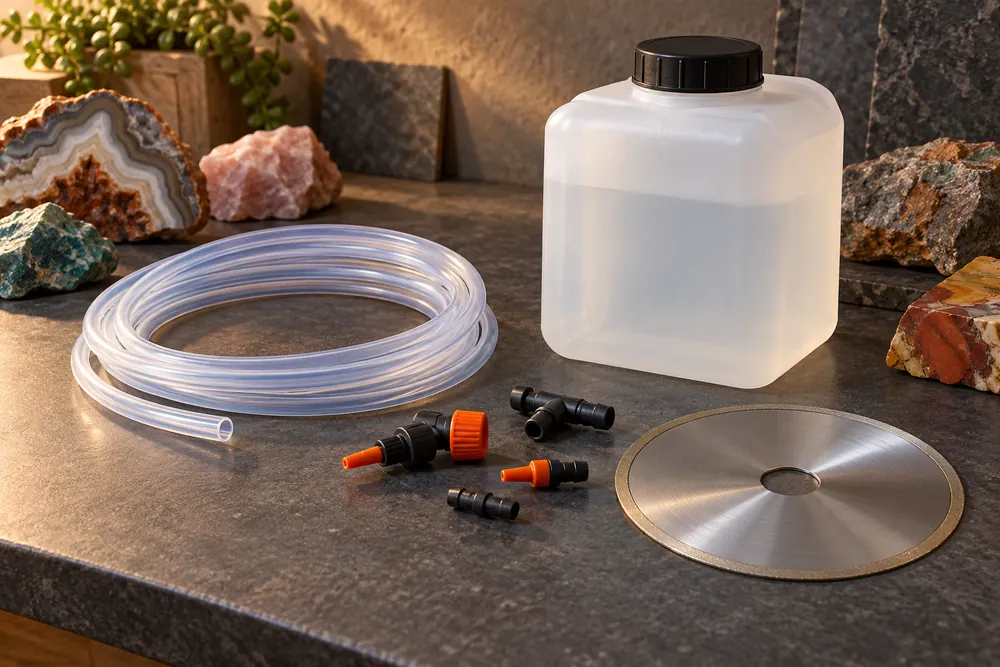
Compare the affected branch with the machine diagram. The official troubleshooting list includes cleaning the nozzles and Y-splits with the supplied pipe cleaner. Use the current manual for access, cleaning and reassembly rather than forcing a tool into an unidentified fitting.
Inspect for visible kinks, disconnected tubing and incorrectly positioned components. Do not dismantle valves or alter pump wiring based on a general internet fix. If the original part is damaged, record its exact identity and obtain a compatible replacement through the manufacturer or a supplier that confirms the model match.
Separate a supply problem from a drainage problem
Water accumulating in a pan is a different symptom from water failing to reach a wheel. The manual addresses drain-tube direction and the pan outspout separately. Confirm the intended downward drainage route and inspect the waste container and visible drain path before assuming the pump is at fault.
Do not increase supply to compensate for water that is failing to leave the machine. Similarly, a blocked outlet does not become acceptable because another wheel receives water. Resolve the affected path according to the manual before resuming the relevant operation.
Why the pump rating is not your refill schedule
CabKing’s FAQ lists the pump output rating, but that figure is not a measurement of water actually delivered through your adjusted wheel outlets. Hose routing, controls and the operating arrangement affect the installed system. We have not measured its working consumption.
For planning, record actual clean-container usage during an otherwise correctly operating session, following the manual. For example, an entirely hypothetical two liters used in half an hour equals four liters per hour. That calculation illustrates record keeping; it is not a CabKing specification or a recommended valve setting.
Keep the single-pass system intact
CabKing’s FAQ explicitly rejects setting its water system up for recirculation and warns of a warranty consequence. Preserve a separate clean supply and waste collection route. Returning used slurry to the wheels is not the manufacturer’s solution to a small supply container or weak flow.
If repeated sediment or contamination appears in the clean side, investigate the source rather than normalize it. The broader water and drainage planning guide explains how to keep the two paths identifiable without inventing a universal workshop plumbing design.
What to send support
Provide the machine model, revision, voltage, pump label and a concise symptom history. Include photographs of the isolated external routing and affected fitting. State whether the problem affects every outlet or one branch and whether the waste side drains normally.
Ask for the appropriate current diagram and exact replacement part where necessary. Our parts identification guide provides an inquiry format. Keep electrical-service and water-routing questions distinct so a replacement component is selected for an identified problem.

When the machine should stay out of use
Do not resume if water delivery remains inadequate for the intended operation, components leak near electrical equipment, or there is a damaged cable, pump or connection. Obtain manufacturer or appropriate professional assistance. A successful-looking moment of flow does not establish that an unresolved electrical fault is safe.
After authorized cleaning or replacement, follow the manual’s return-to-operation checks. Record what was changed and the exact part installed. That creates a useful service history if the symptom returns, rather than a sequence of undocumented modifications.
Sources and verification
Sources checked October 22, 2026. Manufacturer specifications and manuals describe the equipment; our selection and planning advice is editorial analysis. We have not physically tested these products. Confirm the exact revision and current instructions before ordering or operating.
A DETAIL CHANGED?
Help keep this guide accurate.
Send the model number and a link to the current specification.