
Accessories / Buying guide
Best Cabochon Templates for Lapidary Work: 6 Options Compared
Compare clear, stainless, aluminum and two-sided template options by the actual outlines, size checks and layout jobs they support.

Research-based guide · We have not physically tested these products. How we research
Jump to a section
THE SHORT ANSWER
For seeing a slab’s pattern while choosing an outline, compare John Heusler’s translucent templates and Covington’s clear-plastic option. For metal templates, shortlist Kingsley North Cool Cabs 2, Covington’s aluminum doubles, or Diamond Pacific’s blue and red Gem-Temp products according to the shapes needed. Buy the actual outlines and sizes you will use, rather than the largest advertised number of holes.
The best cabochon template helps you make a specific layout decision before cutting. It can show the outline you intend to trace and help repeat a design. It cannot establish whether a stone is sound, guarantee that a finished cabochon fits a setting or replace careful measurement. This guide compares six purchasable options selected for material, outline choice and single- versus double-sided layout needs.
These are six product or configuration choices, not six unrelated brands. Covington’s plastic single and aluminum double are deliberately separated because visibility and two-sided marking are different needs. Diamond Pacific’s blue and red products are related templates with different outline groups. We have not tested marking accuracy, edge wear or long-term durability. The recommendations explain documented buying fit rather than declare a measured winner.
| Option | Need it addresses | Published material / format | Main order check |
|---|---|---|---|
| John Heusler templates | View stone pattern through a varied-outline template | Semitransparent pliable PVC | Choose the actual numbered design; older series availability varies |
| Kingsley North Cool Cabs Template 2 | A stainless template with a different shape mix | Stainless steel | Check outlines and size range on the selected sheet |
| Covington plastic single | A clear basic tracing option | Clear plastic single | Choose color/shape group and single-sheet configuration |
| Covington aluminum double | Mark both faces of a suitable slab | Paired aluminum template configuration | Confirm shape group and double selection |
| Diamond Pacific blue Gem-Temp | Ovals and circles | Anodized aluminum; single/double choices | Select blue and the intended sided format |
| Diamond Pacific red Gem-Temp | Miscellaneous shapes | Anodized aluminum; single/double choices | Check the specific outline group rather than color alone |
Amazon buttons open product-name searches, not confirmed matching offers. Specialist suppliers may be the appropriate purchase source for these exact products. Verify the selected sheet and configuration on the source page before comparing an alternative listing. Shopping-link disclosure.
A translucent varied-outline option
John Heusler Cabochon Templates

This range is worth investigating when you want to position an outline around color, banding or another visible feature. SUVA describes semitransparent pliable PVC sheets and several numbered designs. Choose the actual sheet whose openings suit your planned stones; the family name alone does not identify the shapes in your order.
- Material
- Semitransparent pliable PVC
- Design selection
- Numbered sheets; a and b series
- Useful distinction
- Visibility of the slab through the template
- Availability caveat
- Selected older designs may not be replenished
The supplier distinguishes newer b-series designs from older sheets and warns that some older versions cannot be replaced once sold out. That makes a replacement plan relevant if you intend to repeat a particular outline over time. Record the selected design number rather than save only a photograph of the family assortment.
Transparency is useful for viewing the surface, but it does not prove the absence of internal fractures. Move the outline around the slab and consider the full intended cabochon, not just the attractive center. Before buying for a calibrated jewelry setting, obtain the actual opening dimensions and compare them with the setting’s requirements.
Reasons to consider it
- Semitransparent material helps visual placement
- A choice of numbered designs
Tradeoffs to check
- Family photograph does not show the exact selected sheet
- Older-design replacement availability needs checking
Before ordering: Choose one design number and confirm its outlines, dimensions, stock status and material before ordering.
Amazon button opens a model search, not a verified offer. Confirm the exact item, seller and availability. Shopping-link disclosure.
A stainless-steel outline alternative
Kingsley North Cool Cabs Template 2

Cool Cabs Template 2 is the metal option to investigate when its specific outlines are what you want to repeat. Kingsley North identifies stainless steel and describes a scaled set of related sizes. The product is a different design choice from a basic oval-and-circle sheet, not evidence that advanced shapes produce a more valuable finished stone.
- Material
- Stainless steel
- Product
- Cool Cabs Template 2
- Design description
- Scaled sizes with a more complex outline mix
- Primary task
- Repeatable cabochon or inlay planning
A metal template does not provide the same see-through area as clear plastic. Consider how you prefer to inspect the slab around an opening and whether the outline group suits the stone. There is little value in buying a complex sheet if most of its shapes do not fit your projects.
Check the current product photograph and ask for dimensions where they are not clear. The description does not establish a certified measurement tolerance, so do not interpret its stainless construction as proof of calibrated jewelry fit. We have not measured hole sizes, edge finish or marking wear. Choose it for an identified design and material preference, subject to confirmation.
Reasons to consider it
- Identifiable stainless-steel product
- A different outline collection from basic geometric sheets
Tradeoffs to check
- Opaque material changes slab visibility
- Exact dimensions should be confirmed for setting-specific work
Before ordering: Confirm that Template 2 is the intended design and that its actual size range suits your projects.
Amazon button opens a model search, not a verified offer. Confirm the exact item, seller and availability. Shopping-link disclosure.
A clear single-sheet tracing format
Covington Clear Plastic Single Gem Marking Template

Choose this configuration when you want a clear basic template and only need to trace one face at a time. Covington offers several materials and formats on the same product page, which means the default listing price does not identify the configuration shown in every photo. Select plastic, single and the intended shape group deliberately.
- Material
- Clear plastic
- Configuration
- Single template
- Selection
- Color-coded shape group
- Related options
- Metal singles, doubles and selected sets
The clear material is the practical reason to compare it with a metal single. You can inspect more of the slab beneath the sheet while positioning an opening. That can help the layout decision, but it does not guarantee a sound blank or a particular finished yield. Marking accuracy still depends on the actual opening, tool and material.
Compare one useful sheet with the available set before adding more designs. A set may be convenient, but only if its additional shape groups serve your work. The family image can show several templates at once; it is not a quantity promise. Keep the selected configuration in the order record so a replacement request is unambiguous.
Reasons to consider it
- Clear material for visual layout
- Single-sheet choice avoids buying an unnecessary double
Tradeoffs to check
- Many configurations share one page and family photograph
- Set contents and quantities must be selected explicitly
Before ordering: Select the plastic single and exact shape group. The photo represents the product family, not necessarily one supplied sheet.
Amazon button opens a model search, not a verified offer. Confirm the exact item, seller and availability. Shopping-link disclosure.
A two-sided slab-marking configuration
Covington Aluminum Double Gem Marking Template
This is the Covington configuration to investigate when your process calls for corresponding marks on both slab faces. The manufacturer describes doubles as a paired format for that task. Its value is a defined layout function, rather than a claim that a double always improves cutting accuracy or finishing time.
- Material
- Aluminum
- Configuration
- Double template
- Use described
- Mark both sides of a slab
- Set caveat
- Doubles are not offered in the listed sets
The product page offers aluminum doubles separately and states that doubles are not included in sets. That distinction can easily disappear when someone compares only the headline starting price or a family photograph. Ask the seller to confirm the paired construction and selected shape group, especially if ordering through a marketplace with abbreviated option names.
A two-sided outline does not reveal the stone’s internal structure or guarantee that both surfaces are parallel. Inspect and measure the actual slab. If your work only needs one traced face, a clear or metal single may be the simpler purchase. We keep this double separate in the guide because its intended use differs from the clear single, while openly identifying both as configurations of one family.
Reasons to consider it
- Defined purpose for corresponding marks on two faces
- Metal paired format available as a distinct selection
Tradeoffs to check
- Not the same order as an aluminum single
- Doubles are excluded from the listed sets
Before ordering: Choose aluminum double, confirm the shape group and get the paired format stated on the order confirmation.
Amazon button opens a model search, not a verified offer. Confirm the exact item, seller and availability. Shopping-link disclosure.
Ovals and circles in a metal format
Diamond Pacific Blue Gem-Temp Templates
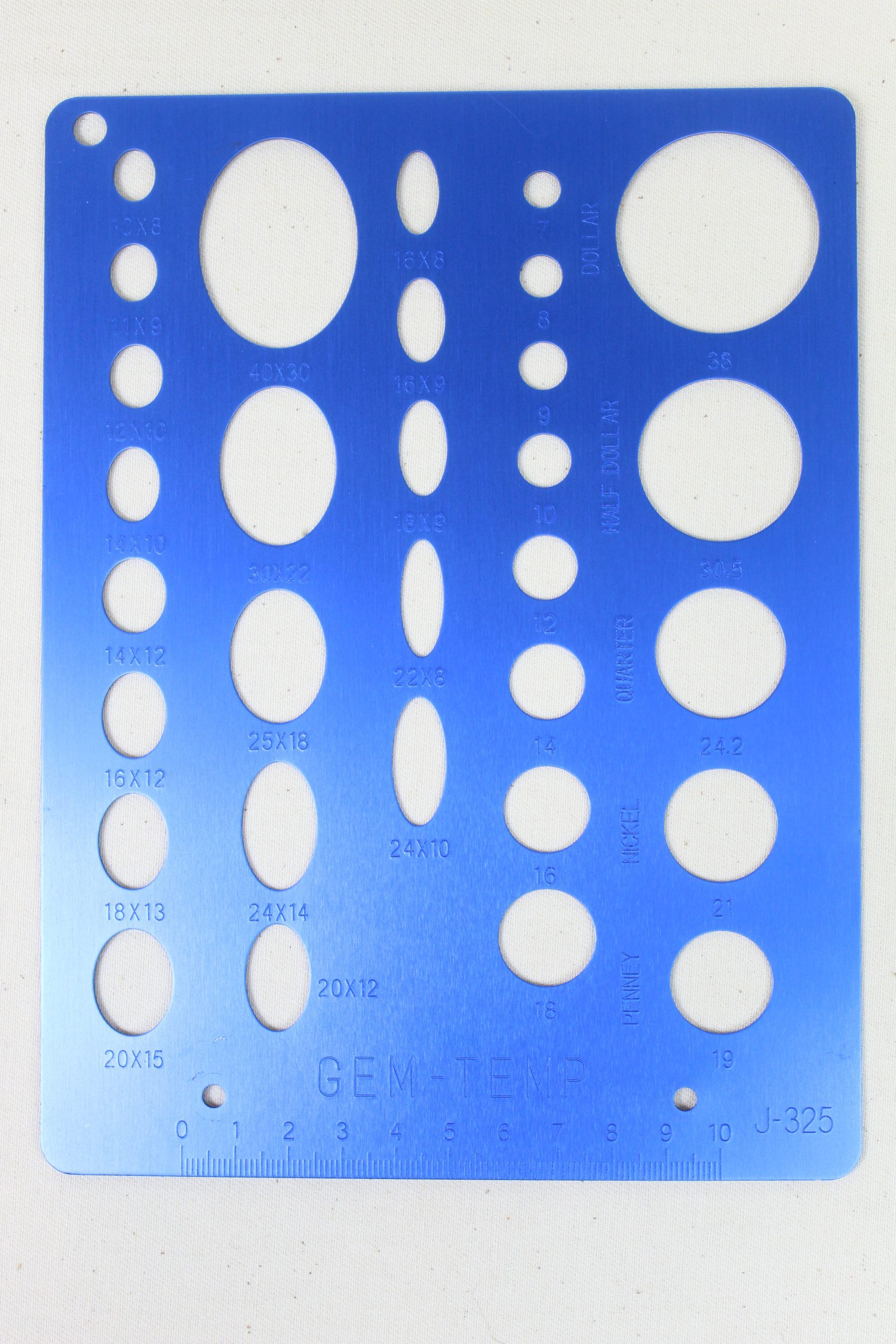
The blue Gem-Temp product is the focused comparison for buyers who primarily want oval and circular outlines. Diamond Pacific identifies anodized aluminum and offers single- and double-sided versions. Start by checking the actual opening sizes you need; blue is a family identifier, not a universal dimensional standard across brands.
- Outline group
- Ovals and circles
- Material
- Anodized aluminum
- Options
- Single-sided or double-sided
- Identification
- Blue product group
For repeated work, a smaller collection of relevant shapes may be more useful than an assorted sheet with many unused cutouts. If the design is intended for a purchased setting, compare the real setting with the proposed finished stone and ask for the template dimensions. Do not assume a nominal oval label includes every aspect of girdle thickness, dome height and corner geometry.
The double-sided option serves the two-face marking task described by the maker. Choose it only where that workflow is useful and verify the exact configuration. The product photo may show a family example rather than all formats. We have not tested dimensional repeatability or resistance to wear, so those remain questions for the supplier rather than measured benefits in our ranking.
Reasons to consider it
- Focused oval-and-circle product group
- Choice of one- or two-sided format
Tradeoffs to check
- Exact opening sizes must match the intended work
- Sided format changes the selected product
Before ordering: Confirm blue ovals/circles, opening dimensions and single- or double-sided construction.
Amazon button opens a model search, not a verified offer. Confirm the exact item, seller and availability. Shopping-link disclosure.
An additional miscellaneous-outline group
Diamond Pacific Red Gem-Temp Templates
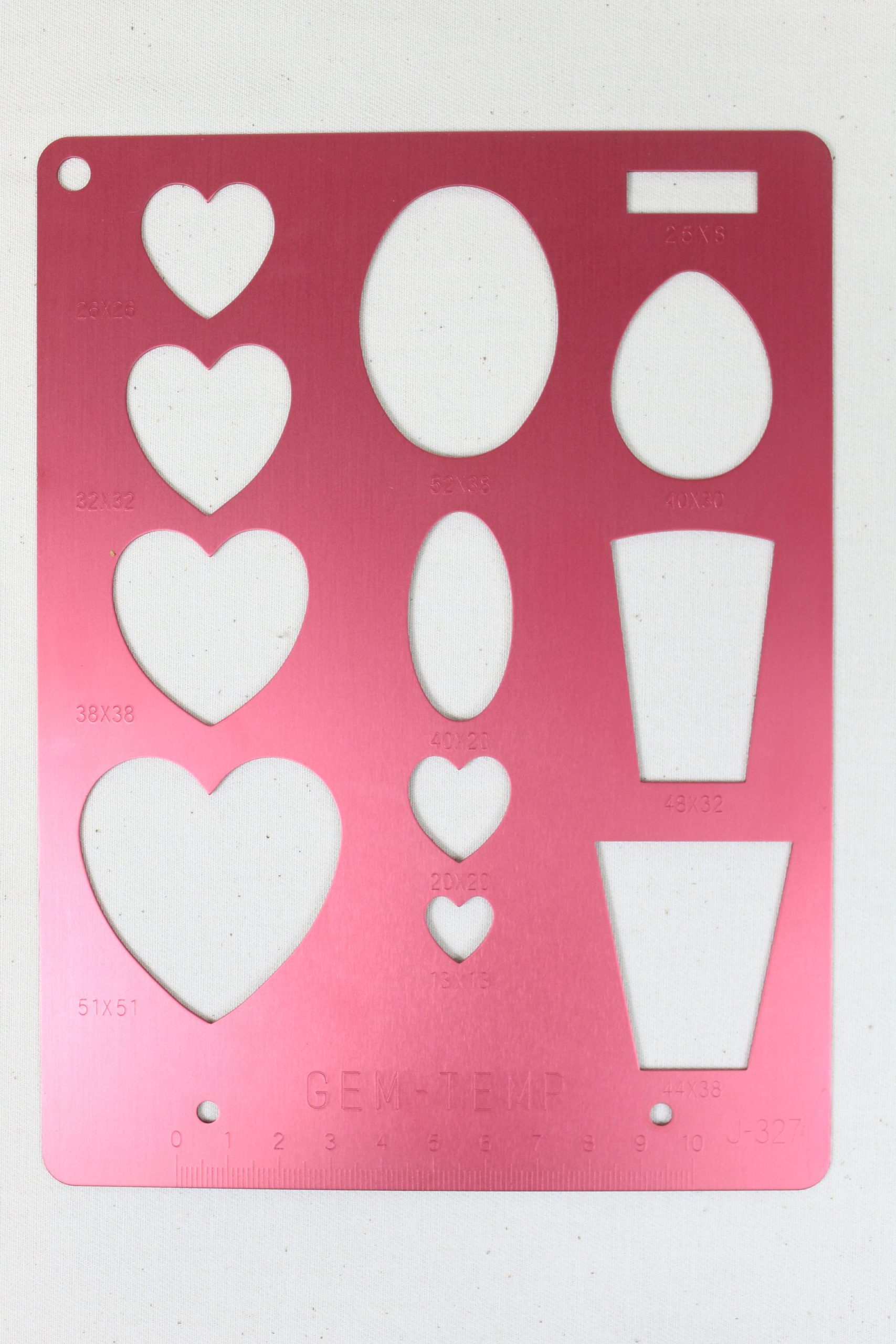
The red Gem-Temp product is worth comparing when oval and circular outlines do not cover the designs you want. Its miscellaneous-shape group is a separate purchase from the blue product. Look at the exact openings before ordering: a broad description such as miscellaneous does not establish which shape will fit your slab.
- Outline group
- Miscellaneous shapes
- Material
- Anodized aluminum
- Options
- Single-sided or double-sided
- Related family
- Blue ovals/circles and gold rectangular group
The practical question is whether this adds a useful outline to what you own. Compare the sheet against your present templates and avoid buying overlapping designs simply to complete a color set. If only one unusual shape matters, request its actual dimensions and confirm that it is present in the selected product rather than assume it appears somewhere in the range.
This is a related Gem-Temp family choice, not a different manufacturer competing on demonstrated performance. The guide includes it because shape selection is the main reason to buy a template. The single/double decision remains separate from the red/blue shape decision, and neither proves better accuracy without measured evidence.
Reasons to consider it
- Expands the outline selection beyond ovals and circles
- Material and sided options are identified
Tradeoffs to check
- May duplicate shapes already owned
- Miscellaneous is not a substitute for an actual opening list
Before ordering: Inspect the specific red sheet, confirm useful dimensions and select the intended sided format.
Amazon button opens a model search, not a verified offer. Confirm the exact item, seller and availability. Shopping-link disclosure.
How we selected these six options
We looked for identifiable products with clear material or format differences and a source where the selected configuration can be checked. We excluded the Donald K Olson Great Shapes range from the recommended six because the supplier page marked it discontinued at the time of research, even though it still appeared in search results.
The shortlist is intentionally modest in its claims. Material, visibility, outline groups and sided configuration can be compared from documentation. Accuracy, feel, edge wear and service life require observation or appropriate testing. We do not borrow a maker’s experience or customer photographs and present them as our own.
A recommendation here means “investigate this for this layout need.” It does not mean a template guarantees a saleable cabochon, avoids all waste or provides a precise fit to a jewelry component. Where a key dimension is missing, asking the seller is part of the recommendation rather than a detail to hide.
Buy the outline and size you need before choosing the material
Make a short list of planned shapes and their approximate dimensions. Then compare the actual openings on the sheet. Many product pages show an assortment without listing every opening clearly. Request a dimensioned photograph or written size list if the distinction affects your purchase.
For a first cabochon project, an outline you can inspect and describe is more useful than a large count of unfamiliar shapes. Consider whether its curves and corners suit your material and available shaping equipment. The template is a planning tool; it does not remove the need to understand the operation required to produce that outline.
If you already own a useful oval sheet, a second oval assortment may contribute little. A different size, a needed complementary shape or a two-sided format might solve a real gap. Build a collection around projects rather than buying several overlapping packs because their photographs look different.
Clear plastic versus metal: what the specification can tell you
A transparent or semitransparent sheet can help you position an outline while seeing more of the slab. An opaque metal sheet shows the surface through the opening but obscures more of the surrounding area. That visibility distinction is relevant when working around an attractive pattern.
Metal and plastic also describe construction, but the material label alone does not provide a tested lifespan, marking tolerance or resistance to every chemical and tool. We have not measured those properties. Ask how the manufacturer intends the template to be marked, cleaned and stored, and use a suitable marking tool for both the sheet and stone.
Do not translate pliable into indestructible or stainless into scratch-proof. A template is still a physical reference whose edges and markings need inspection. If an outline appears damaged or a dimension is important, check it rather than assume the brand name guarantees the current condition.
Single versus double: choose around the actual marking task
A single template marks one face at a time. A double format is offered for corresponding marks on both slab faces. Decide whether that two-face task is part of your process before paying for the extra format. It does not automatically make sense for every beginner or every stone.
Confirm that the listing actually says double or paired. A product photo showing two templates can also represent an assortment, alternate variants or a front-and-back view. The selected option and order description should establish what you receive. Save those details with the seller correspondence.
A paired outline should not be treated as an inspection instrument for slab parallelism or internal defects. It establishes a marking arrangement, not a complete assessment of the material. If slab thickness, hidden cracks or a particular holding method affect the next step, address them separately with appropriate instruction.
Templates and calibrated settings: avoid a costly assumption
A nominal 30 × 22 mm oval on a product description does not by itself guarantee that a completed stone will fit a setting sold with the same label. Shape curvature, girdle, thickness and actual component dimensions still matter. Treat the number as a starting specification to verify, rather than a finished-fit warranty.
When buying specifically for a setting, measure the actual setting or obtain its dimensional requirements before selecting the outline. Include an allowance for the work needed to reach the final form according to your instruction, without applying an arbitrary universal margin from a generic article.
For paired earrings or repeated pendants, identify the same actual opening and record the final target dimensions. A template can help repeat the intended outline, but it does not guarantee that the later shaping and polishing remain identical. Inspect the finished pieces against the requirements you started with.
Pattern placement, fractures and useful yield
Move the proposed outline across the slab before committing to a cut. Compare the visual result and consider whether nearby fractures or unsuitable areas affect the whole intended blank. A clear sheet may make this easier to evaluate visually, but viewing a surface is not a reliable declaration that the interior is sound.
A small paper record can be useful: template number, selected opening, material and planned orientation. This is especially helpful when several possible cuts compete for the same attractive area. Photograph the proposed arrangement if that helps you decide, while clearly distinguishing a layout image from evidence of a finished result.
Avoid claims that a template increases yield by a fixed percentage. Yield depends on the actual slab, its defects, the outline and the cuts. We have not measured a waste-reduction figure for any product in the shortlist. The defensible benefit is a visible, repeatable reference for planning.
How to compare prices without buying duplicates
Record the exact sheet, material, sided format and quantity, then add delivery. A single sheet, three-sheet set and double template are different offers even when a search result shows one starting price. The Covington page is a useful example because several options share the same family listing.
Use a cost-per-useful-opening calculation only as a planning aid. If a hypothetical $18 sheet contains three shapes you expect to use, dividing gives $6 per useful shape. A hypothetical $10 sheet with one needed opening gives $10. Those invented numbers do not establish quality; they only make your personal shape priorities visible.
Availability can matter more than a small saving when repeat work depends on one outline. Save the design identifier, ask about replacement supply and keep a record of any seller-confirmed dimensions. Do not treat a discontinued sheet appearing in a search result as a dependable source for future orders.
A practical selection and order checklist
Write the shape, target dimensions, preferred visibility and sided format at the top of the order sheet. Identify whether the product provides all four. If a photograph or selector is ambiguous, ask for the exact configuration in writing. Then confirm quantity, delivery and return conditions before checkout.
On arrival, compare the received sheet with the invoice and selected design. Check markings and visible condition before using it. Where final dimensions matter, verify the relevant openings with suitable measuring equipment and the manufacturer’s dimensional information. This is a useful receiving check, not a claim that we have tested a particular brand’s tolerance.
For the rest of the workflow, use our beginner equipment checklist. If you are deciding how to reduce a marked slab before shaping, read the trim versus slab saw guide. Choose the template around that planned work rather than expecting it to determine the whole equipment purchase.
Frequently asked questions
Do I need several templates to start?
No. Begin with the sheet that provides the outlines and sizes for your first projects. More openings do not necessarily add useful capability if they duplicate what you already own.
Is a clear template always better?
It is useful for seeing more of the slab while positioning an outline. A metal product may still be appropriate if its designs and format suit you. We have no measured durability or accuracy ranking that makes one material a universal winner.
Will a template find hidden fractures?
No. Visibility can help inspect the surface, but the template is not a diagnostic instrument. The condition and suitability of the material need separate assessment.
Are the blue templates identical across makers?
Do not assume so. Color is a product-family identifier, not an industry guarantee of exact opening sizes or manufacturing tolerance. Compare the actual source specifications.
Which should I buy for calibrated jewelry?
Start with the actual setting requirements, then confirm the relevant opening dimensions. A nominal size label alone is insufficient. Keep the finished stone requirements distinct from the traced starting outline.
Why are related products listed separately?
Shape groups and sided configurations solve different buying needs. We explicitly identify the related families so the six options are not mistaken for six independent brands or six tested performance winners.
Sources and verification
Manufacturer and specialist-supplier pages checked October 21, 2026. Specifications can change; the current manual and seller confirmation govern the exact order. Recommendations are editorial judgments about documented fit. We have not physically tested the products.
A DETAIL CHANGED?
Help keep this guide accurate.
Send the model number and a link to the current specification.