
Saws / Review
Hi-Tech Diamond 6-Inch Trim Saw Review: Capacity, Blades & Accessories
What the six-inch saw can accommodate, how its blade options differ, and why the optional vise needs a separate checkout check.
Research-based guide · We have not physically tested these products. How we research
Jump to a section
THE SHORT ANSWER
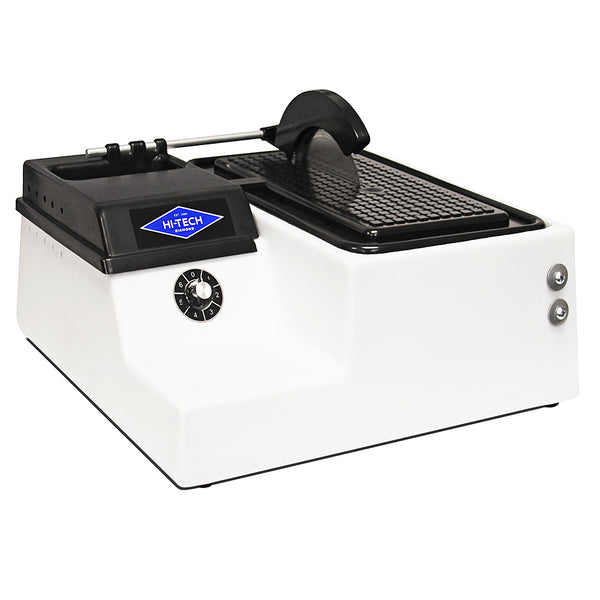
The 6-inch Hi-Tech Diamond is a trim-saw candidate for buyers preparing cabochon outlines from suitable slabs. Its variable speed, two supplied blade types and optional vise are useful purchase distinctions. Its exposed blade height, rather than its six-inch name, limits the material it can accommodate.
| Feature | Manufacturer listing |
|---|---|
| Blade diameter / arbor | 6 inches / 5/8 inch |
| Motor and speed | 1/4 hp; variable 800–3,400 rpm |
| Table | 15.5 × 9 inches |
| Listed blade height / depth | 1.75 / 5.25 inches |
| Reservoir | Up to 16 ounces of water |
| Vise | Separate with-vise and without-vise options |
The job this saw is intended to do
A trim saw removes unwanted material around a planned shape. If you buy prepared slabs and want to reduce the grinding needed around a cabochon outline, this is the relevant type of machine to investigate. It is a separate stage from shaping and polishing the curved cabochon surface.
Write down three typical projects before comparing saws: the material, its dimensions and the cut you need. Include the largest routine piece, not just the smallest demonstration stone. Ask the manufacturer about awkward or irregular pieces whose dimensions alone do not show how they could be supported.
Blade diameter is not cutting height
The quoted blade height is the portion available above the table in the published configuration. The blade center and the table occupy part of the diameter, so the full diameter is never a sensible substitute for usable capacity. The separate depth figure also should not be described as a guaranteed rock thickness.
For example, a buyer choosing between this saw and its smaller or larger relative should compare exposed height, table support and the intended cut together. A slab with a wide outline may sit on a table while still being inappropriate for a particular cut or holding arrangement. Send photographs and measurements to the manufacturer when the fit is unclear.
What the two included blades tell you
The listing includes both notched and sintered diamond blades. Their presence gives you two supplied blade constructions to investigate; it does not mean either blade is suitable for all materials. Match the specific blade diameter, arbor, core and kerf to the current manual and workpiece.
Read our notched versus sintered blade comparison for the construction difference. We do not treat blade color as a reliable specification. Product photos and coatings can change, while the actual part number and published rim dimensions identify what you are ordering.
The optional vise is a purchase choice
The product page offers configurations with and without the saw vise. Check the selected option at checkout rather than assuming a photograph proves it is included. If you already own a vise, ask about its exact compatibility; a similar-looking bracket is insufficient evidence.
The vise is not an automatic feed mechanism. Do not buy this configuration expecting the operating behavior of an enclosed power-feed slab saw. Ask the manufacturer to explain the holding arrangement and permitted operating method for your intended work, then follow the manual. A bigger saw or an added vise does not justify leaving a cut unattended.
Motor speed and blade compatibility
The motor is listed as variable from 800 to 3,400 rpm. That range gives a buyer another compatibility detail to check against a selected blade. It does not mean maximum speed is appropriate for every blade and material combination, or that the lowest setting will solve a poor blade match.
Use the intersection of the machine instructions and the accessory limits. Blade diameter and arbor are necessary fit checks, but guards, flanges, rotation and permitted operating conditions also matter. Do not enlarge holes, remove guards or improvise adapters to make an unapproved blade fit.
Water, cleanup and bench preparation
The manufacturer describes a water reservoir incorporated into the housing, with a removable table providing access. Plan where the filled saw sits, how you will handle draining and how to keep used slurry from contaminating the next finishing stage. The reservoir capacity is not a measured estimate of continuous working time.
Use the coolant specified for the machine and selected blade together. A blade that permits more than one coolant does not automatically authorize all those fluids in the saw. Follow the current instructions for electrical protection, guards, eye protection, cleaning and disposal. This review is a purchase guide, not a substitute operating manual.
The alternatives worth comparing
Compare the smaller 4/5-inch Hi-Tech model when compactness matters and the published capacity fits your work. Compare the 10-inch model when exposed height is the limiting issue. Neither comparison can be settled by blade diameter alone.
Our trim saw versus slab saw guide separates the jobs. It helps prevent spending more for a saw that still does not support the operation you want. Buying prepared slabs or using an appropriate club service may also defer the need to own a second type of saw.
Before-order checklist and review limitations
Confirm the voltage, vise option, included blade specifications, delivered cost and seller return conditions. Ask whether replacement tables, guards, blade hardware and vise components are available for this exact revision. Keep the manual and order confirmation with the machine details.
We have not measured kerf accuracy, cutting speed, vibration, splash control, sound levels or service life. Our recommendation is based on the documented layout and purchase fit. If your decision depends on one of those unmeasured factors, ask for an appropriate demonstration using comparable material before ordering.
Amazon button opens a model search, not a verified offer. Confirm the exact item, seller and availability. Shopping-link disclosure.
Our buying conclusion
Shortlist the six-inch model for trimming suitably sized prepared material when the documented table, blade height and kit suit your projects. A buyer whose rough exceeds its capacity should solve that mismatch before spending on extra blades or accessories.
Keep your first purchase focused on work you can describe clearly. The right question is whether the saw and selected blade support that work safely within their instructions, rather than whether the product has the most impressive generic specification.
Sources and verification
Manufacturer and specialist-supplier pages checked October 21, 2026. Specifications can change; the current manual and seller confirmation govern the exact order. Recommendations are editorial judgments about documented fit. We have not physically tested the products.
A DETAIL CHANGED?
Help keep this guide accurate.
Send the model number and a link to the current specification.