
Saws / Planning
Choosing a Saw for Geodes: Capacity & Holding Checks
Measure the actual geode and confirm the approved cut and holding system before choosing a saw by blade diameter.
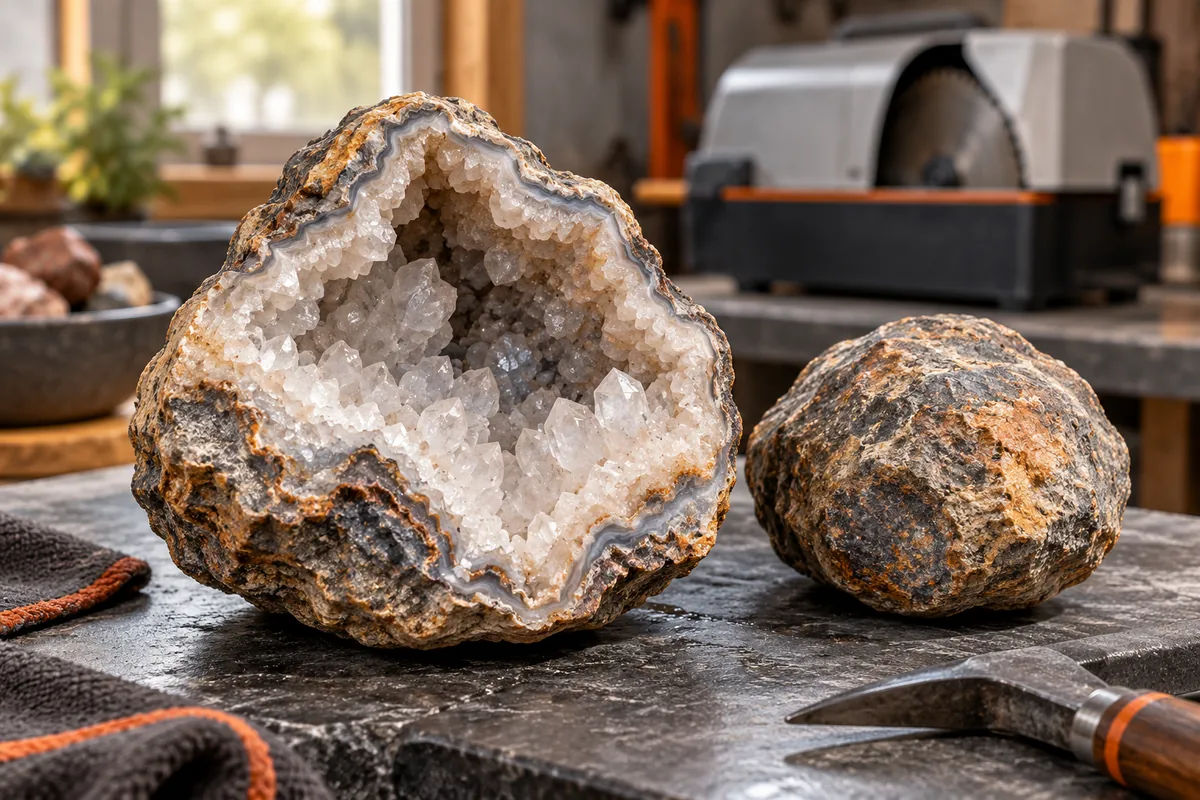
Research-based guide · We have not physically tested these products. How we research
Jump to a section
THE SHORT ANSWER
A saw for geodes must suit the outside dimensions, irregular shape, supported cut and manufacturer-approved holding arrangement. Blade diameter by itself is insufficient. For occasional geodes, obtaining a suitable cutting service can be a better first decision than buying a saw whose capacity is still uncertain.
| Field | What to record | Why it matters |
|---|---|---|
| Outside dimensions | Length, width, height and projections | The complete envelope must fit the supported operation |
| Shape | Round, elongated, irregular or already partly cut | A simple diameter does not describe holding |
| Desired result | One opening cut or repeated slabs | These are different capacity and feed questions |
| Material information | What is known about the shell and contents | Blade recommendation needs an identified material |
| Holding system | Manufacturer-approved vise/support and permitted size | Table space alone does not secure an irregular piece |
| Machine capacity | Exposed blade height, cut path, vise envelope and clearance | Nominal blade diameter is only one field |
First decide whether you need an opening cut or slabs
Opening a geode for display and preparing repeated parallel slabs are different jobs. Tell the supplier which result you want before comparing machine categories. The number of cuts, required holding and available finished material affect whether owning equipment makes sense.
Avoid choosing a trim saw just because a product listing says it cuts rock. Trim saws are often discussed around preparing outlines from suitable slabs. If you start with a whole irregular nodule, its support and capacity questions must be answered separately.

Measure the complete outside shape
Record three dimensions and photograph the actual geode from several directions. Include prominent projections rather than measure only the smoothest central portion. Identify where you hope the cut will pass without treating a photograph as a guarantee of the internal structure.
A round-looking object still needs an approved holding arrangement. Do not assume a vise opening equal to one measurement establishes that it can retain the piece through the intended cut. Ask the manufacturer to assess the actual workpiece and requested result.
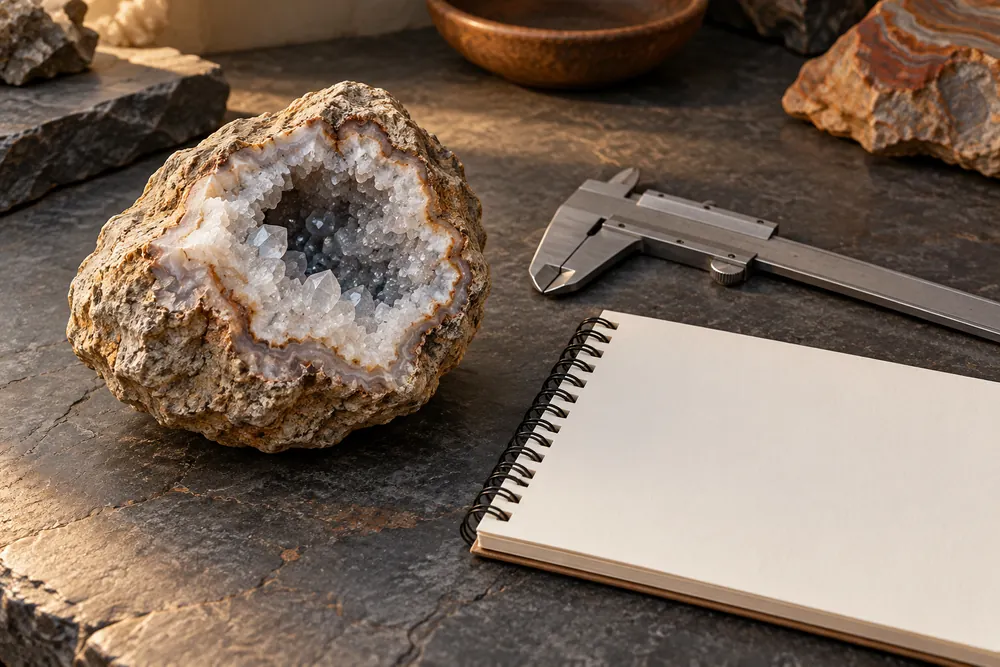
Why a ten-inch blade does not mean a ten-inch geode
The Hi-Tech ten-inch tabletop saw lists a blade height of 3.75 inches above the table. That example shows why nominal diameter should not be used as the material-height limit. Other dimensions and the chosen holding arrangement also constrain the supported cut.
Consider an illustrative geode measuring five inches across. Neither the word ten-inch nor a large table proves that this workpiece can be cut as intended. Send its dimensions and shape to the maker instead of inventing a multi-position cutting method to exceed the documented configuration.
Check the vise, feed and clearance as a system
For enclosed slab saws, ask about the vise envelope, jaw contact, cross-feed and permitted cut path. Confirm whether the machine has manual, weight or powered feed in the selected version. A closed hood or an optional vise does not establish automatic feed.
The Covington combination and heavy-duty saw documentation illustrates how machine families have their own carriage and feed arrangements. Use the current manual for the actual model. Do not construct a generic holding jig or use loose packing based on a broad geode article; suitability needs manufacturer confirmation.
Blade material advice should name the actual product
Describe the known material and ask for an exact blade recommendation. A general label such as agate geode still does not identify the correct diameter, arbor, rim, core, speed or coolant. Keep the saw requirements and blade requirements together when comparing a recommendation.
Our blade compatibility guide records those fields. The construction comparison explains why one rim type is not a universal solution. We have no measured geode-cutting time or blade-life result to offer.
Include the workshop and delivery requirements
A saw purchase includes stable placement, operating clearance, access for loading, required coolant and a workable waste-handling arrangement. Freight equipment and heavier machines may require delivery planning beyond the advertised body footprint. Quote the installed system rather than the bare machine.
For an occasional display piece, compare that complete expense with an appropriate club or commercial cutting service. Ask about the size limit, accepted materials, scheduling and damage terms. Do not assume every rock shop or club has equipment or a service suitable for the actual geode.
A useful message to send the manufacturer
Provide the model you are considering, outside measurements, photographs, known material and intended result. Ask: “Can this exact workpiece be held and cut within your approved configuration? Which holding accessory, blade and coolant do you specify? What dimensions or shapes would rule this model out?”
A helpful reply identifies limitations and the actual configuration. If the answer remains uncertain, defer the purchase or obtain an assessment in person. A claim that the saw handles large rocks is too broad to settle this particular buying decision.
Where to compare machine types
Use the workflow comparison before the product shortlist. Our ten-inch tabletop review explains its capacity fields and optional-vise limit; the slab-saw guide compares other documented setups.
This article is a sizing and holding worksheet, not a six-product ranking or operating tutorial. Its purpose is to get a geode-specific suitability answer before money is spent. No machine is recommended for an unassessed workpiece solely because its blade diameter looks large enough.
Sources and verification
Sources checked October 22, 2026. Manufacturer specifications and manuals describe the equipment; our selection and planning advice is editorial analysis. We have not physically tested these products. Confirm the exact revision and current instructions before ordering or operating.
A DETAIL CHANGED?
Help keep this guide accurate.
Send the model number and a link to the current specification.