
Saws / Comparison
Trim Saw vs. Slab Saw: Which Do You Need?
Match your starting material and intended cuts to saw capacity, holding and feed type before buying.

Research-based guide · We have not physically tested these products. How we research
Jump to a section
THE SHORT ANSWER
Choose a trim saw for preparing outlines from suitable slabs; investigate a slab saw when you need to cut rough into slabs. Check the actual machine layout, capacity and feed mechanism. The words “trim” and “slab” on a listing do not establish those details by themselves.
| Starting material / task | First option to investigate | What still needs checking |
|---|---|---|
| Prepared slab; cut around a cabochon outline | Trim saw | Usable height, support, blade and holding |
| Uncut rough; make repeated slices | Slab saw | Vise capacity, feed type and workpiece shape |
| Occasional slabs for a small cabbing bench | Buy prepared slabs or use a suitable club service | Material quality, access and total cost |
| Mixed trimming and slabbing | Purpose-designed combination or separate saws | Each operation’s capacity and configuration |
Start with the material, not the machine name
Consider two buyers. One buys a flat slab and marks a cabochon outline on it. The other has an irregular nodule and wants several parallel slices. Both want to cut rock, but their support, holding and capacity requirements differ substantially. A single product category label does not resolve those differences.
List the typical dimensions of what you buy, its shape, the cuts you want and how often you expect to do them. That short description is more useful to a seller than asking whether a saw is good for beginners. It also exposes whether you need to own a saw immediately.
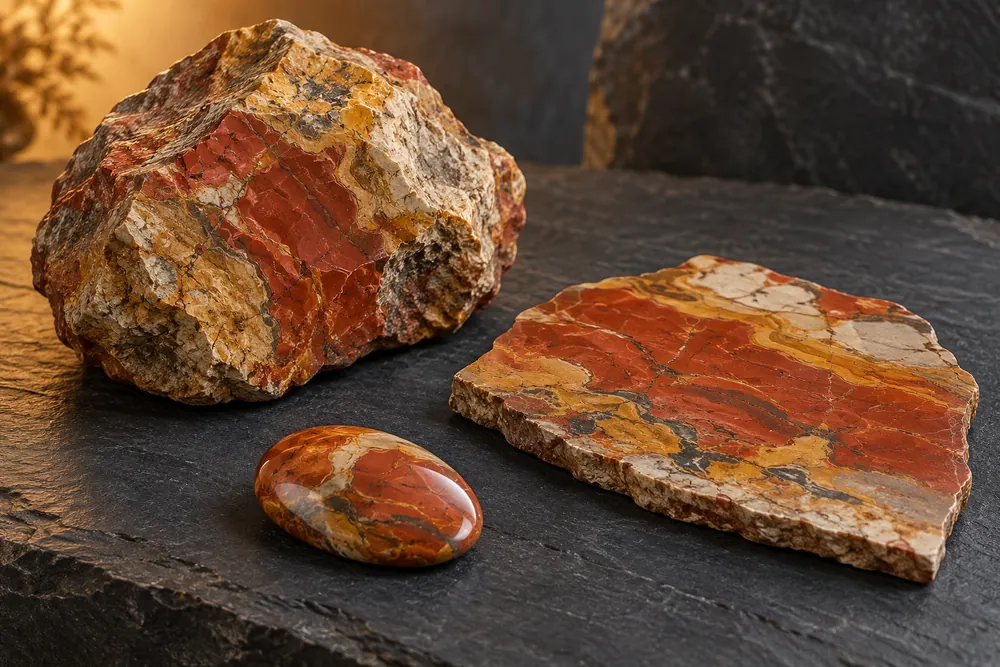
What a trim saw contributes to a cabbing bench
Trimming reduces unwanted material before the grinding stage. For a buyer working from prepared slabs, it can complement a cabbing machine or flat lap without requiring a separate rough-slabbing workflow. The saw does not perform the later shaping, sanding and polishing stages.
The Hi-Tech Diamond six-inch review illustrates the specification checks: table size, exposed blade height, arbor, speed range and vise option. These details identify a possible fit; they do not prove a cut will be faster or cleaner than another machine.
What a slab saw must accommodate
A rough-slabbing purchase starts with the actual rock and its holding arrangement. Confirm the maximum dimensions for the chosen vise and cutting path, including irregular projections. The blade diameter is only one part of this assessment. A blade substantially wider than a rock does not guarantee the rock can be held or advanced correctly.
Some slab saws provide a manufacturer-designed feed mechanism; others marketed for slabbing remain tabletop machines. Distinguish manual advancement, weight feed and powered feed in the exact specification. Ask the seller to identify the mechanism rather than infer it from a hood or vise in a photograph.
A useful comparison: six-inch versus ten-inch Hi-Tech
The six-inch model lists 1.75 inches of exposed blade height and a 15.5 × 9-inch table. The ten-inch lists 3.75 inches and a 19.75 × 12-inch table. Both have optional vise configurations. These manufacturer figures demonstrate why blade diameter and useful capacity should be recorded separately.
The ten-inch model should not be described as an automatic slabbing system just because it is larger. Its optional vise does not supply automatic power feed. A buyer seeking repeated feed-controlled slices needs to compare the appropriate enclosed machines as a separate group.
Do you need both machines?
Not necessarily. Someone purchasing suitable slabs may need trimming access while having no reason to own a large rough saw. Someone focused on preparing slabs for other cutters may prioritize rough capacity before owning a full cabbing station. Work backward from the product you want to make.
Use a simple annual-cost comparison. Estimate saw access fees or slab purchases, then compare them with delivered machine cost, compatible blades, approved coolant, maintenance and space. Label usage assumptions clearly. The machine becomes worthwhile through the work it enables, rather than because an accessory bundle makes the checkout total look attractive.
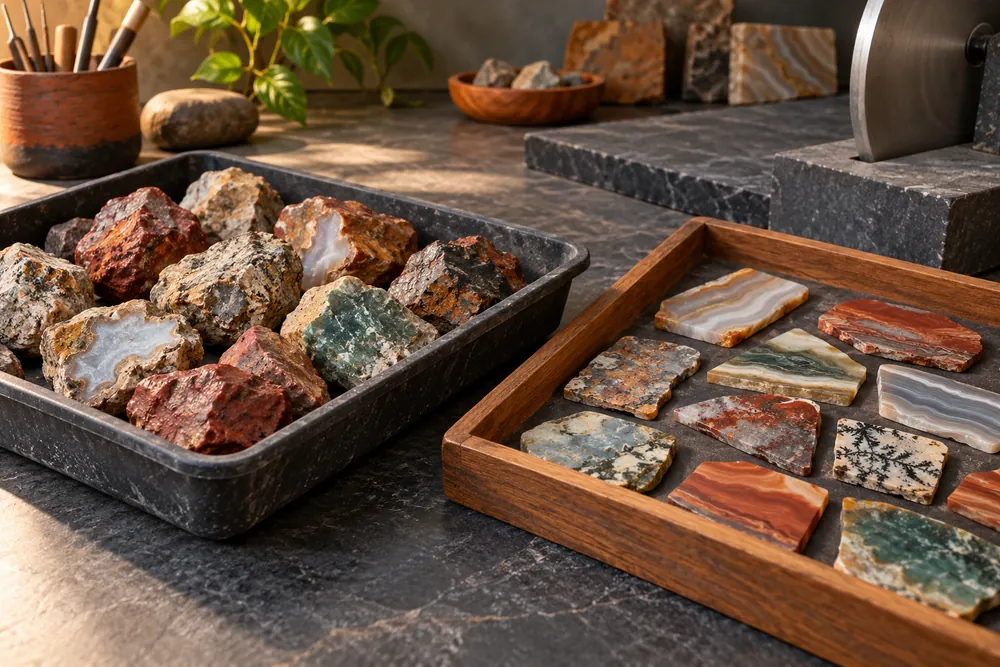
Blade and coolant selection are separate decisions
A blade must fit the machine and the intended material. Record diameter, arbor, kerf, core, rotation and permitted operating conditions. The presence of a spare blade in a kit should not override those checks. Two saws with the same arbor do not necessarily accept the same blade diameter.
Follow both the machine and blade instructions for coolant. Do not assume a fluid allowed for a blade is approved for every motor housing or reservoir. Avoid improvised guards, electrical modifications or unsupported holding methods. Read the current operating manual before deciding where the saw will sit.
Purchase questions that reveal the real configuration
Ask: Is the vise included in this exact option? What are its permitted workpiece dimensions? How is the cut advanced? Which blade is supplied? What space is required for loading, draining and service? Does delivery include a stand or require freight arrangements?
Have the seller separate the machine specification from optional accessories. A complete-looking product photograph is useful for orientation, but the order line items establish what you receive. Save written answers so a later replacement-parts order starts from the right revision.
Where to compare specific machines
Our trim-saw buying guide covers machines to compare for smaller preparation work. The slab-saw guide separates tabletop, feed-equipped and larger workshop options. Read the capacity and included-kit notes before comparing prices.
Choose the smallest complete system that supports your routine work within its instructions, while allowing for a clearly identified next step. Extra capacity without a defined use adds cost and space; inadequate holding or height cannot be fixed by calling the machine versatile.
Sources and verification
Manufacturer and specialist-supplier pages checked October 21, 2026. Specifications can change; the current manual and seller confirmation govern the exact order. Recommendations are editorial judgments about documented fit. We have not physically tested the products.
A DETAIL CHANGED?
Help keep this guide accurate.
Send the model number and a link to the current specification.