
Saws / Equipment guide
Lapidary Saws Explained: Trim, Slab and Contour-Cutting Choices
Choose a saw format using the intended cut, material support, feed system and complete setup requirements.

Research-based guide · We have not physically tested these products. How we research
Jump to a section
THE SHORT ANSWER
Choose a lapidary saw by the job it must do: trimming prepared material, making slabs from rough, or following an approved contour-cutting workflow. Then compare support, usable capacity, feed arrangement and coolant requirements. “Rock saw” and blade diameter are too broad to settle the purchase.
| Job | Format to investigate | Purchase question |
|---|---|---|
| Trim a prepared slab toward a preform | Trim saw | Can the table and holding arrangement support this piece? |
| Make repeated slices from rough | Slab saw | How is rough held, advanced and indexed? |
| Follow contours in suitable material | Suitable diamond band or ring saw | Does the maker approve the material, thickness and cut? |
| Open an irregular nodule | Machine assessed for that specific task | Can it be held securely within the documented capacity? |
Begin with the material you actually own
A buyer starting with purchased slabs has a different cutting requirement from someone bringing home large nodules. List the smallest routine piece, the largest routine piece and the cuts you want to make. Include thickness, shape and any irregular projections that affect support. “Agate” alone does not define the machine requirement.
Describe the output as well. Removing waste around a cabochon outline, slicing several parallel slabs and preserving a delicate specimen are different tasks. If one unusual oversized rock is driving the entire purchase, compare having that job performed by an appropriate lapidary service with owning and maintaining a much larger machine.
What a trim saw contributes
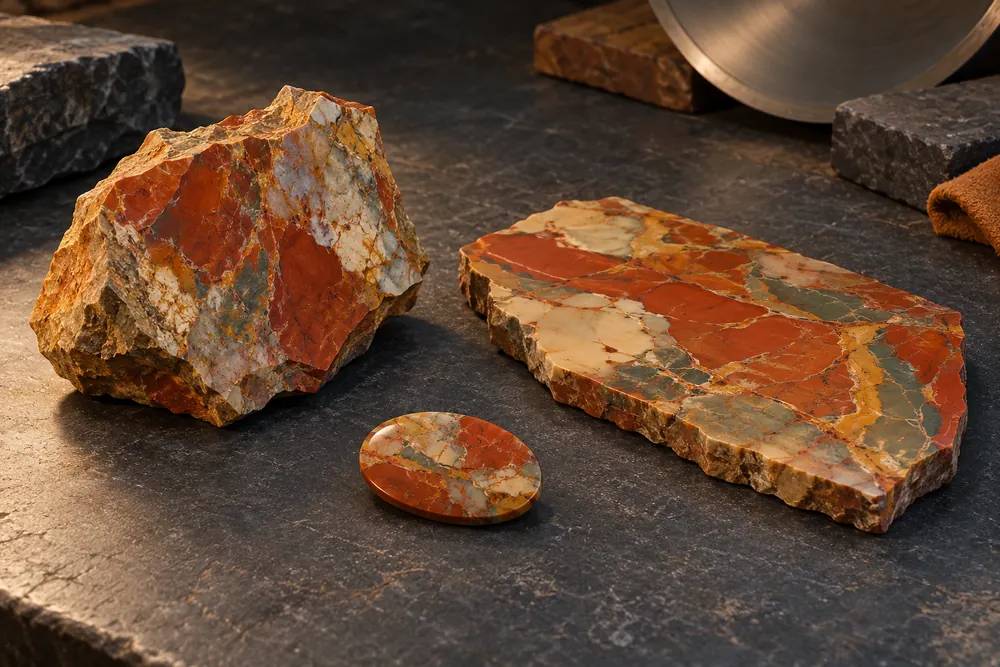
A trim saw is the format to investigate for reducing suitably prepared material before grinding. Table size, access around the blade and approved holding methods are key comparison fields. A compact machine can be appropriate for a defined small task, but a small purchase price is not evidence that it can handle your complete rough inventory.
Our trim-saw buying guide compares actual machines. Use its product shortlist after deciding what needs supporting at the cut. A manual vise, where offered, should not be described as an automatic feed system. Read the exact accessory description rather than assuming that every option called a vise has the same function.
What changes when you need slabs
Slabbing adds questions about the vise opening, carriage travel, feed mechanism, indexing and the way coolant is managed. A larger circular blade is only one component. The machine must accommodate the shape of the rough and the intended approach to the cut under its instructions.
Compare a manually fed tabletop saw with a larger enclosed feed saw as different systems. Consider weight, delivery, stand requirements, cleaning access and service arrangements. A powered feed does not remove the operator’s responsibilities or authorize unattended use. Our slab-saw buying guide keeps those equipment distinctions visible.
Band and ring saws need a separate suitability check
Contour-cutting equipment is worth investigating when the intended material and project justify it. Do not assume a machine designed or marketed for glass is approved for every gemstone. The same suitability question applies when considering a tile saw for irregular rocks. Check the manufacturer’s exact material guidance, blade, maximum thickness, cooling arrangement and restrictions before considering a purchase.
Conversely, do not try to make a circular lapidary blade follow a curve because a band saw can follow one. Hi-Tech specifically describes its circular diamond blades as straight-cut tools. Identify the tool that supports the required operation rather than pushing an existing machine outside its intended role.
Read capacity as several dimensions
Usable cutting height, table dimensions, throat or depth limitations, vise opening and carriage movement may all matter. No single number replaces the others. For example, a nominal ten-inch blade is not a statement that a ten-inch rock can be cut. The table and shaft occupy part of the blade’s diameter.
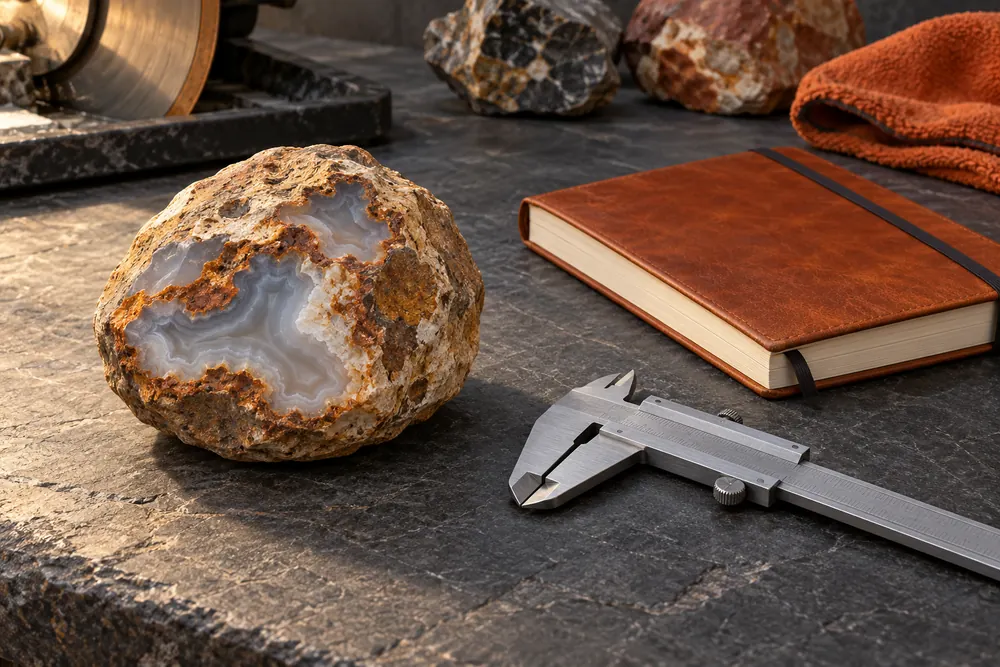
For an irregular object, ask the maker to assess photographs and measurements. Our geode saw worksheet is useful when an uneven nodule complicates the choice. Do not improvise multi-sided cuts or unsupported positioning to overcome a stated capacity limit.
Check blades, coolant and power together
Blade diameter and arbor are the beginning of compatibility. Construction, speed limits, mounting requirements and approved coolant must agree with the machine instructions. A blade listing that permits oil does not authorize oil in every machine, and a general coolant recommendation does not override the saw’s requirements.
Write the electrical variant into the order, including voltage, frequency and the requirements of separate accessories. Confirm local suitability and support before importing. The electrical buying checklist explains the information to collect without offering wiring conversions.
Compare the complete first year, not an advertised package alone
Request an itemized basket: saw, supplied blade, any necessary holding accessory, approved support or stand, delivery, tax and expected consumables. Mark unknown items rather than estimating them as zero. Keep optional upgrades separate so they do not obscure the cost of getting the intended job supported.
Finish with service questions. Who identifies replacement parts? Where is the manual? What return terms apply to a wrong configuration? Can the seller confirm that the specific rough and task fit the equipment? A well-defined purchase with support is more useful than a nominally versatile saw bought before the work is understood.
Sources and verification
Sources checked October 22, 2026. Manufacturer specifications and manuals describe the equipment; our selection and planning advice is editorial analysis. We have not physically tested these products. Confirm the exact revision and current instructions before ordering or operating.
A DETAIL CHANGED?
Help keep this guide accurate.
Send the model number and a link to the current specification.