
Saws / Application guide
Choosing a Lapidary Saw for Agates: Slabs, Nodules and Rough
Match the intended agate cut with table support, holding range, blade fit and complete setup costs.
Research-based guide · We have not physically tested these products. How we research
Jump to a section
THE SHORT ANSWER
Choose a saw for agates by the starting material and intended cut. Prepared slabs point toward trimming; repeated slices from rough point toward a suitable slab-saw setup. Measure the actual piece and confirm its holding arrangement before using blade diameter or the word “agate” as a buying shortcut.
Three agate projects, three different purchase briefs
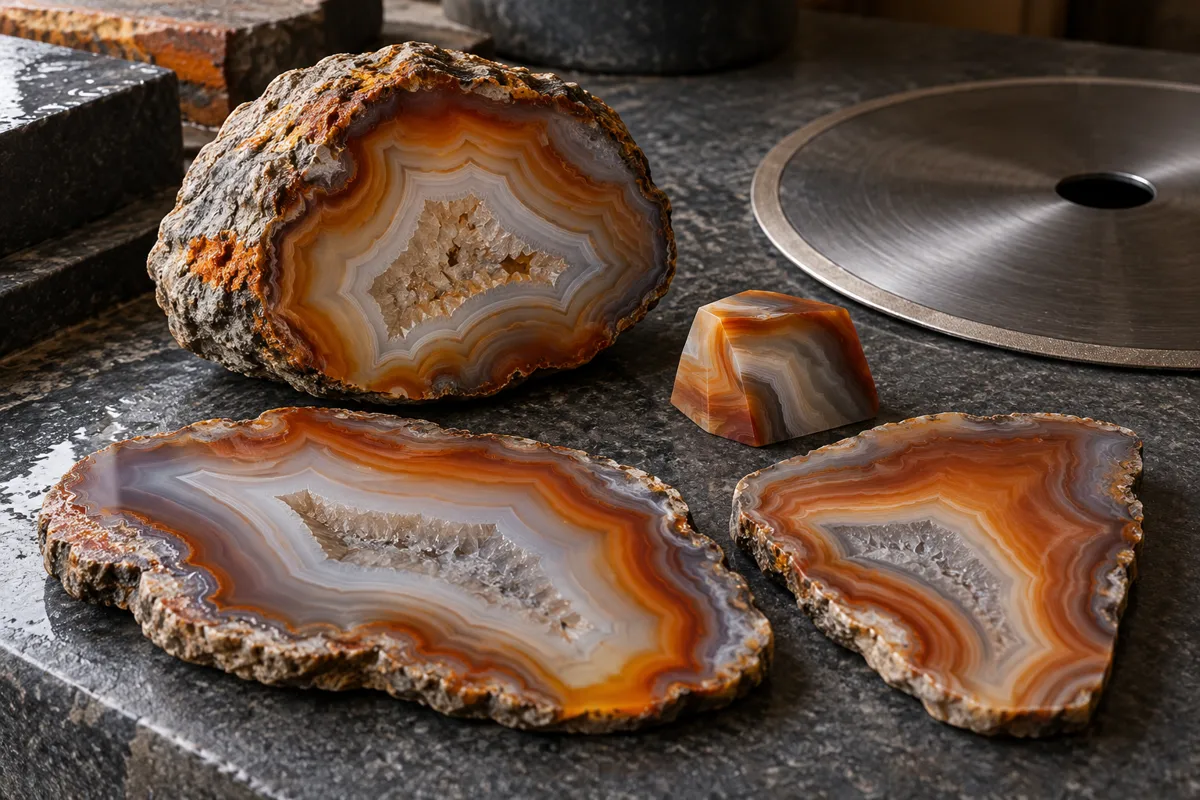
First describe what is on the bench. A thin purchased slab, a rounded nodule and an irregular chunk of rough may all be agate, yet they create different support and cutting requirements. Record length, width, thickness, irregular projections and the cut you want to make. A photograph with a scale helps the manufacturer assess a difficult piece.
Then state the desired output. Trimming around a marked cabochon, opening a nodule for display and producing several parallel slabs are distinct jobs. Buying a machine around the name of the mineral can hide that distinction. Our trim versus slab saw comparison starts with those workflows.
| Starting material | Intended result | Equipment question |
|---|---|---|
| Prepared slab | Cabochon preform | Is the slab supported on the trim table throughout the approved cut? |
| Rough nodule | Several slabs | Does the vise and feed arrangement accommodate its actual shape? |
| Uneven specimen | Display face | Can the manufacturer confirm suitable holding and material preservation? |
| Very large one-off piece | One exceptional cut | Would an appropriate lapidary cutting service be more practical? |

For slabs, compare support before motor size
The Hi-Tech six-inch trim saw is a documented example of a machine intended for trimming cabochon and faceting material. Its published table measures 15.5 × 9 inches, while its blade height is a separate capacity field. Those dimensions help define the support envelope; they do not prove that every slab within that rectangle can be handled appropriately.
Write down how the material reaches and passes the blade under the manual. Include any approved vise option in the comparison. A manual vise is not an automatic feed. Read the six-inch trim-saw review if this is the actual format you need.
For rough, examine the vise, feed and clearance
A slab saw purchase should account for the rough’s shape, the holding range, carriage movement and intended slice. The ten-inch Hi-Tech saw lists a 3.75-inch exposed blade height. A ten-inch blade therefore does not mean a ten-inch-high nodule fits. Other saws may have very different holding systems even when their nominal blade size is similar.
Ask the maker to assess an irregular nodule rather than inventing a way to balance it. The irregular-nodule worksheet is useful for recording measurements and projections. Do not plan rotating, unsupported or multi-sided cuts merely to bypass a stated limit.
Blade choice is a compatibility decision
Confirm the approved diameter, arbor, mounting arrangement, speed and material application. A thinner kerf can reduce nominal material removed in a cut, but it is not an independent promise of a better result. Equipment condition, support and the blade’s intended use remain important.
Diamond Pacific’s blade-selection guidance considers material value alongside machine characteristics and operator experience. Use that as a reminder to compare the whole setup. Our blade-fit checklist separates those fields instead of naming one blade as universally suitable for every agate.
Coolant and cleanup belong in the order
Check the intersection of saw instructions, blade requirements and approved liquid. A blade marketed for water or oil does not establish which liquid belongs in the particular saw. Include the reservoir, access for cleaning and waste handling in your workshop plan.
Avoid assigning a fixed cutting speed, blade life or number of slabs per fill from someone else’s result. We have not measured those outcomes. The coolant guide provides an approval worksheet, while the water planner helps keep supply and used material organized.
Value the cut before choosing the machine
For an exceptional specimen, discuss orientation and expected material loss with a competent lapidary service or instructor before committing to equipment. The most visually obvious cut is not necessarily the cut that preserves the feature you want. A photograph and clear objective make that discussion more useful.
Compare a service quote with the complete ownership basket: machine, blade, holding accessory, suitable support, delivered charges and consumables. If most of your work begins with purchased slabs, a specialist service for occasional large rough may leave a smaller and better-defined home setup.

A practical shortlist rule
Use the trim-saw guide for supported cuts in prepared material and the slab-saw guide for equipment intended for rough slicing. Compare named configurations only after the workpiece brief is clear.
Before payment, ask the seller to confirm the exact model, electrical version, supplied blade, guards, holding option and current manual. If the seller cannot explain how your proposed agate fits the approved setup, leave that question unresolved rather than treating a larger motor or more expensive blade as the answer.
Sources and verification
Sources checked October 22, 2026. Manufacturer specifications and manuals describe the equipment; our selection and planning advice is editorial analysis. We have not physically tested these products. Confirm the exact revision and current instructions before ordering or operating.
A DETAIL CHANGED?
Help keep this guide accurate.
Send the model number and a link to the current specification.